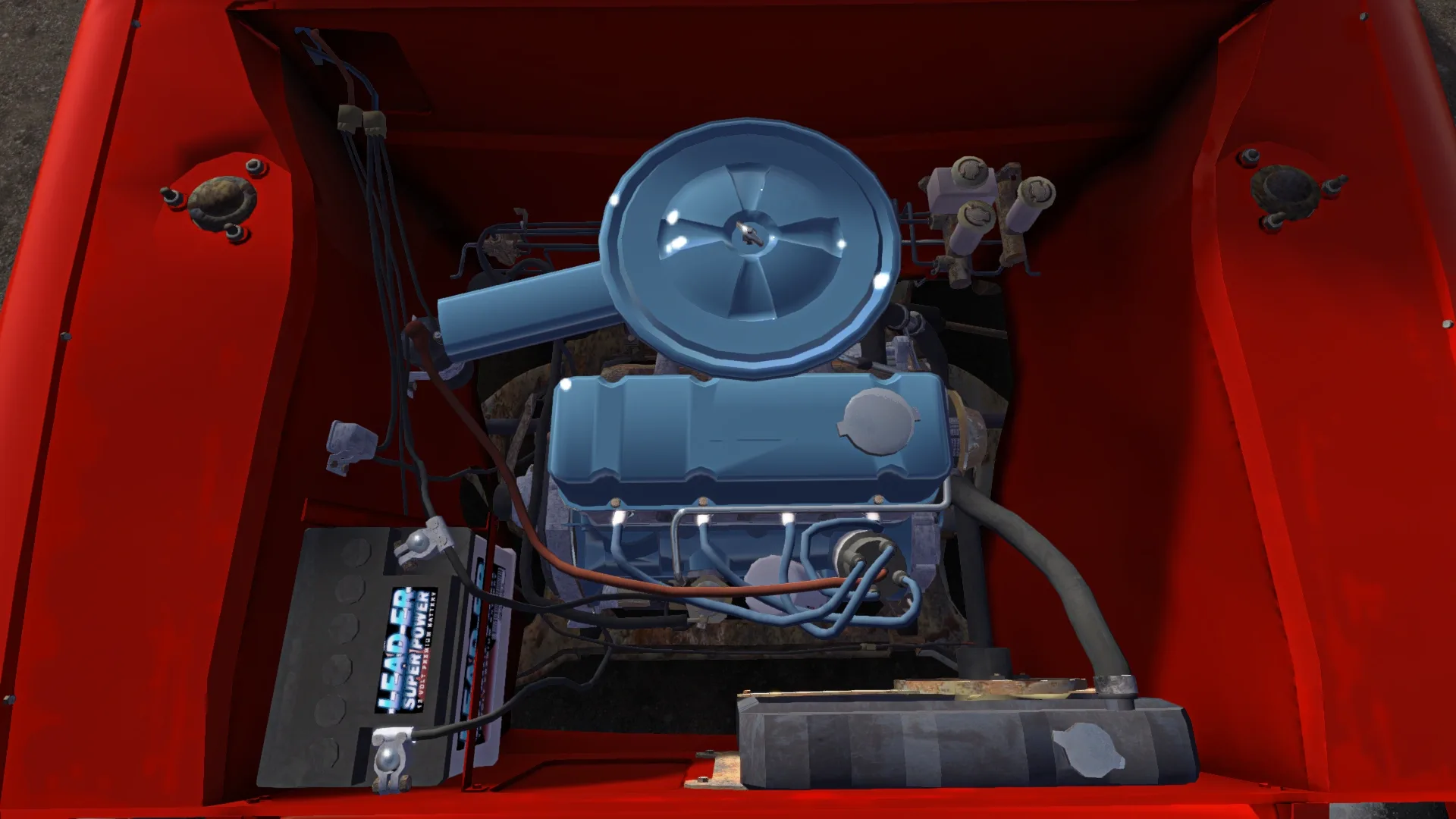
Engine Tuning Guide
From Cold Start to Race Performance
The Corris Rivett's engine is a detailed mechanical simulation. This guide covers carburetor tuning, AFR readings, cold start procedures, distributor timing, the rev limiter, and the difference between inspection tuning and performance tuning.
Engine Overview
The Corris Rivett uses a 2.0L OHC inline-4 engine producing 97–98 HP at 5,500 RPM in stock form.
Carburetor Types
Three carburetor options are available. Each affects power, tuning behavior, and inspection compatibility.
| Type | Stock On | Notes |
|---|---|---|
| Standard (Single-barrel) | All stock Rivetts | Default factory carb. Easiest to tune. |
| Twin / 2-barrel | GT/SLX NE models | More power. Passes inspection. Recommended upgrade. |
| 4-barrel (Racing) | Aftermarket only | Maximum power. Community reports tuning can be unstable. Best paired with race cam. |
Air-Fuel Ratio (AFR)
AFR measures the mass ratio of air to fuel. 14.7:1 is stoichiometric — the theoretical perfect burn. Purchase an AFR gauge from the AMIS Auto magazine to monitor it.
How to Read AFR
At idle, AFR jumps around constantly — this is normal. For an accurate reading, drive in 3rd or 4th gear at steady throttle. When the number stabilizes, that is your true AFR. A reading of 18+ means the mixture is too lean to ignite.
| AFR Value | Meaning | Use Case |
|---|---|---|
12–13 | Very rich | Race cam performance builds |
13.0–13.5 | Rich | Cold start without choke |
13.5–14.0 | Slightly rich | Recommended daily driving (winter) |
14.0–14.5 | Slightly lean | Fuel-efficient general driving |
14.7 | Stoichiometric | Theoretical perfect burn |
14.5–15.0+ | Lean | Required for passing inspection |
18+ | Too lean | Engine will not ignite |
Carburetor Tuning Procedure
You need a flat-head screwdriver. The mixture screw is on the carburetor body.
Base Tuning (Getting the Engine to Start)
- 1Turn the mixture screw UP (clockwise) at least 60 clicks — this goes all the way up
- 2Turn the screw back DOWN (counterclockwise) the following number of clicks:
Standard (single-barrel): 23 clicks
2-barrel: 24 clicks
4-barrel: 23–24 clicks (each screw individually)
3The engine should now be roughly tuned and will start
Fine Tuning with AFR Gauge
- 1Warm the engine to operating temperature first (critical!)
- 2Scrolling UP (tightening) = leaner mixture = higher AFR
- 3Scrolling DOWN (loosening) = richer mixture = lower AFR
- 4Target AFR depends on your goal — see AFR Reference Table above
Mouse Settings Note
Distributor Timing
Distributor timing affects engine power and smoothness. Incorrect timing causes pinging or poor performance.
Timing Adjustment Procedure
- 1Loosen the distributor with a screwdriver
- 2Turn approximately 80 clicks counterclockwise until resistance stops
- 3Tighten by turning 26–28 clicks clockwise
- 4Secure the distributor
Fine Tuning
Rev Limiter
The Corris Rivett has NO factory rev limiter. This aftermarket part prevents engine destruction from over-revving.
Installation
Mounts above the ignition coil, next to the left front headlight. Secured with 1 screw. Adjust desired RPM limit with the switch (range: 5,000–10,000 RPM). Note: actual peaks can overshoot by ~500 RPM.
| Configuration | Setting | Notes |
|---|---|---|
| Stock engine | 7,000 RPM | Safe daily limit |
| Tuned engine | 8,250 RPM | For performance builds |
| Maximum safe | 8,500 RPM | Absolute ceiling |
| Engine destruction | 9,000+ RPM | Engine blows up |
Why You Need a Rev Limiter
Inspection vs Performance Tuning
These have completely different goals and require retuning between them.
| Aspect | Inspection Tuning | Performance Tuning |
|---|---|---|
| AFR Target | 14.5–15.0+ (lean) | 12–13 (rich) |
| Carburetor | Stock or twin-carb | 4-barrel racing carb |
| Camshaft | Stock | Rally (217 HP) or Race (245 HP) |
| Exhaust | Complete stock with muffler | Racing exhaust / sidepipe |
| Choke | Must be fully OFF during test | Used for cold starting |
| Distributor | Conservative timing | Aggressive — 1 click from pinging |
Performance Build Tiers
| Configuration | Approx. HP | Drivability |
|---|---|---|
| Stock engine | 97–98 HP | Excellent |
| Rally cam + twin-carb | ~185 HP | Good, mild idle chop |
| Rally cam + racing carb, tuned | ~217 HP | Moderate, needs attention |
| Race cam + racing carb + race exhaust | ~245 HP | Poor idle, stalls easily |
The race cam is designed for 4,000–8,500 RPM. The engine will stall at low RPM even when warm. Racing cam does not work well with 2-barrel carb (will backfire).
Engine Maintenance
Regular maintenance prevents breakdowns and extends engine life.
| Part | Interval | Source |
|---|---|---|
| Spark plugs | Every 15,000 km (gap 0.6mm) | PSK Gas Station |
| Air filter | Every 5,000 km or once per season | PSK Gas Station |
| Oil filter | Regular changes | PSK Gas Station |
| Fuel filter | Every 10,000 km | PSK Gas Station |
| Fan belt | Carry a spare, replace when worn | PSK Gas Station |
| Coolant | Check levels regularly | PSK Gas Station |
Common Engine Problems
| Problem | Likely Cause | Solution |
|---|---|---|
| Engine won't start (cold) | No choke, dead battery, flooded | Pull choke, crank 10s, release choke, pump gas, retry |
| Engine flooded | Over-cranking, too much gas pedal | Remove carb, save game, re-bolt carb |
| Backfire through carb | Too lean/rich, timing off, valves too tight | Check AFR, distributor timing, valve adjustment |
| Engine stalls when cold | Normal with racing cam; insufficient warm-up | Keep revs up, use choke, warm up longer |
| Engine won't warm up | Bad blower, thermostat, or heaterbox | Replace thermostat (60 mk at Fleetari) |
| Excessive piston wear | Over-revving, no rev limiter | Install rev limiter, limit RPM |
| Failing emissions | AFR too rich, choke on, engine cold | Tune lean (14.5–15+), choke off, warm 30–40 min |
| Engine pinging/knocking | Distributor timing too advanced | Retard timing by 1 mouse wheel click |
Engine Tips
- 1Always warm the engine for 30–40 minutes before going to inspection. A cold engine fails emissions.
- 2Install a rev limiter before doing any performance driving — one over-rev can destroy the engine.
- 3The twin-carb passes inspection and is the best daily upgrade over the single-barrel.
- 4Use the block heater when parked overnight. Unplug before starting.
- 5For base tuning: 60 clicks up, then 23 clicks down (single-barrel) or 24 clicks down (twin-barrel).
- 6Read AFR at steady throttle in 3rd/4th gear, not at idle — idle readings bounce constantly.
- 7Different camshafts require different valve clearance settings. Stock: intake 25 / exhaust 45 clicks down.
- 8Fleetari can do a factory spec engine adjustment if you're struggling with tuning.
Frequently Asked Questions
What AFR should I target for inspection?
Target 14.5–15.0+ with choke fully off and engine at operating temperature. Some players report needing AFR above 15 to pass.
Does the twin-carb pass inspection?
Yes. The twin/2-barrel carburetor passes inspection. It provides more power than the stock single-barrel and is the recommended daily upgrade.
How do I know if my engine is warm enough?
The thermostat opens at 82°C. Drive for 30–40 real minutes after loading a save. The temperature gauge on the dashboard should show operating range.
What RPM destroys the engine?
The engine is fragile above 8,000 RPM and will blow up at 9,000+ RPM. Install a rev limiter and set it to 7,000 (stock) or 8,250 (tuned).
Why does the race cam stall at idle?
The race cam is designed for 4,000–8,500 RPM. Low RPM stalling is normal. It requires a racing carb and richer mixture (AFR 12–13) to function properly.